
By Angela Rodgers, APMP – Bid Consultant at BidWrite
By Angela Rodgers, APMP – Bid Consultant at BidWrite
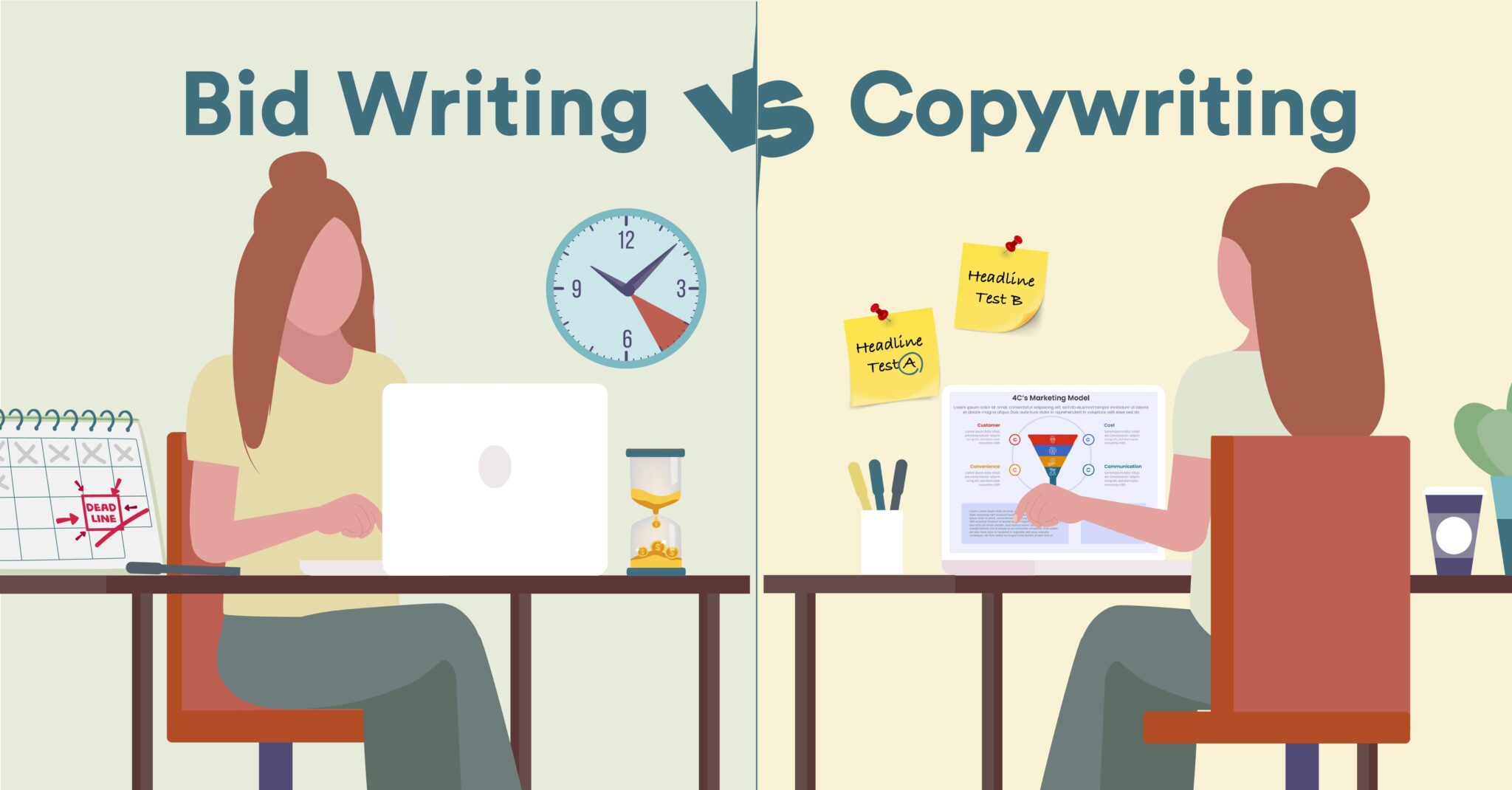
Bid writing and copywriting are both writing-heavy professions, but they serve very different purposes and require distinct skills. If you have a copywriting background and are considering a move into bid writing, you may be curious whether your skills will transfer.
After 13+ years in marketing and copywriting, I began to explore whether bid writing could be my next step. Spoiler alert: it was – and I’m now happy to be part of the team at BidWrite!
Since joining BidWrite, I’ve met many others working in bids who, like me, came from marketing or content roles. I’ve also spoken to many experienced bid writers, read through winning submissions, and even delivered a few successful proposals of my own.
I quickly discovered that while there are similarities, there are just as many differences between copywriting and bid writing. And although not every copywriter will suit a career in bidding, for some, bid writing will be a natural next step.
So, whether you’re thinking about applying for a bidding role, completing some tender training, or just want to compare these careers, let me give you a head start. I’ll walk you through some of the differences I’ve seen, the overlaps, and what I’ve learned from my transition into bid writing.
By definition: bid writing vs copywriting
Let’s start with some simple definitions.
Bid writing is the process of writing persuasive proposals (or ‘bids’) in response to formal procurement requests (like a Request for Tender/RFT) that showcase your organisation as the best choice to win a specific contract.
Copywriting is the practice of writing marketing or advertising content that educates, engages, and ultimately persuades an audience to take specific actions – such as buying a product or enquiring about a service.
Both involve a lot of writing, research, strategy, and persuasion. But in practice, what’s the difference between bid writing and copywriting?
6 key differences between bid writing and copywriting
Copywriting and bid writing differ in a number of ways, from audience targeting and lifespan, to deadlines and outcomes.
1. Hyper-specific audience targeting
Key difference: Copywriting tends to have a broad audience; bid writing targets a very specific reader.
Marketing copywriters typically consider a broader audience at varying stages of the buying journey. Some may be familiar with your brand but unaware of your solution. Some are encountering you for the first time, while others are customers who’ve purchased from you in the past.
However, when you write a tender response, your target audience is hyper-specific. You know the buyer, and you might even know the individual evaluators. This allows you to do detailed background research and tailor your bid to focus on what the buyer values.
2. A direct approach
Key difference: Marketing copy often takes the long way ‘round, while bid writing gets straight to the point.
Because a marketing audience might not be aware of problems or solutions, and may not be ready to buy (yet), copywriters will typically need to ease the reader in. Copy will educate and reassure them before presenting an offer. If you’re too direct, it can feel pushy and turn readers off.
However, bids and proposals are part of the sales process. The buyer already knows they need your product or service and has asked you to propose a solution. They expect you to be direct. Most of the time, their RFT documents tell you exactly what information they need and in what format. So it’s beneficial to dive straight into explaining who you are, what you have to offer, and why it’s better than the alternatives.
3. The deadline dominates the process
Key difference: Copy deadlines have some flexibility, but tender submission deadlines are rock-solid.
In marketing, there’s often some flexibility in deadlines. If someone delays the brief or wants to go through round after round of feedback, you might have the wiggle room to accommodate them without enforcing your originally planned timeline.
In bidding, deadlines are absolute (unless extended at the buyer’s discretion). Tender close dates force bidders to carefully schedule a writing plan – and stick to it. Contributors and collaborators must meet their deadlines, or your submission is at risk. If you miss the submission deadline entirely, your bid won’t be compliant, so the buyer has the right to reject it – costing your organisation a potential contract.
4. Limited visibility and learning opportunities
Key difference: Copy’s goal is maximum visibility, while bidding happens behind closed doors (making it trickier to learn!).
Most marketing content (such as website copy, blog articles, or social media posts) lives in public spaces – where visibility in search engines, newsfeeds or generative AI citations is one of the main goals. This means keywords and SEO (search engine optimisation) strategies play a significant role in planning and drafting content. For aspiring copywriters, learning opportunities are everywhere. You can study successful campaigns, analyse high-converting landing pages, and reverse-engineer effective email sequences.
In contrast, tender responses are ‘commercial in confidence’. A final submission is seen only by the bidding team who creates it, a few internal stakeholders, and the procurement professionals who evaluate it. This secrecy makes bid writing hard to learn on your own. Effective bid strategies are crafted behind closed doors, submissions aren’t made public, and few companies openly share their bidding expertise. Aspiring bid writers typically need both formal training and hands-on mentorship to develop their tendering skills on the job.
5. Shorter lifespan and higher stakes
Key difference: Copywriting ROI is gradual (with opportunities to update), but bids get only one chance to make an impact.
Copywriting often delivers a return on investment over a long period of time. Digital marketing content can continue to perform long after initial publication, and updates can be made to keep it relevant. A strong landing page, blog post, or email sequence can drive results almost indefinitely. This longevity means the value of copywriting can compound over time, so there’s less pressure to deliver ROI right from the start.
Meanwhile, bid writing has a very short lifespan with much higher stakes. Each response is crafted for a specific tender opportunity, and contracts can be worth millions of dollars, if not more. Once the procurement decision has been made and the contract awarded, the writing has done its job. Naturally, there’s a lot of pressure on bid writers to get things right because they don’t get any opportunities to iterate after submission. That said, bid writers tend to reuse or repurpose their best content (ideally housed in an up-to-date bid library) to make the next bid more efficient, giving some sections another life.
6. Crystal clear outcomes
Key difference: Copywriting impact is hard to track; bids have a clear win/lose outcome – with a dollar figure attached.
Although copywriters can track various metrics like website traffic, conversion rates, email opens and search rankings, attributing specific outcomes to individual pieces remains challenging. Multiple factors can influence results, making it difficult to isolate the impact of the copy alone. The long-term objectives copywriting can impact (brand perception, customer loyalty and relationships) are difficult to measure precisely – even with sophisticated analytics tools.
Bid writing delivers black-and-white results. The primary outcome of every tender is crystal clear: you either won the contract or you didn’t. You can measure business impact through the bid’s dollar value, and you can track your own effectiveness as a bid writer with tender win rates. This makes it a lot easier to show the value of and anticipate the ROI from bid writing.
In summary, the 6 key differences between bid writing and copywriting include:
| Aspect | Copywriting | Bid Writing |
|---|---|---|
|
Audience |
Broad – varying stages of awareness |
Specific – known buyer organisation and evaluators |
|
Approach |
Indirect, nurturing |
Direct, solution-focused |
|
Deadlines |
Often flexible |
Fixed and non-negotiable |
|
Visibility & Learning |
Public-facing, plentiful learning resources |
Confidential, on-the-job learning required |
|
Lifespan |
Long-term, updateable |
Short-term, high-stakes |
|
Outcome |
Hard to measure and attribute |
Clear win or loss, measurable value and win rate |
The similarities between bid writing and copywriting: strategy, messaging, and drafting process
Despite all the differences, bid writing and copywriting aren’t complete opposites – they share some fundamental skills and processes. Similarities include:
Starting with strategy
Copywriters and bid writers both start with a strategy – defining audience, competitors, positioning and key messages. This aligns the content with business goals and the target audience.
Translating complex topics
Most writers (especially those in a technical industry) will talk to stakeholders and subject matter experts to inform their content. Both bid writers and copywriters translate those complex, technical inputs into understandable, engaging content.
Writing to persuade
Whether you’re writing ads, blogs, or bids, the main goal is to persuade. Skilled bid writers and copywriters use persuasive writing techniques without being obvious or formulaic. They’ll work to establish trust and credibility with readers, backing claims with evidence and examples.
Careful styling and editing
Attention to detail and careful editing are essential for all writers – often following a three-draft process and favouring plain English and formatting (space, tables, bullets, headings etc.) to improve clarity and readability. Experienced bid writers and copywriters balance word-heavy documents with suitable visual elements and follow style guidelines to ensure consistency.
If you’ve been confidently applying the above techniques and processes in your work as a copywriter, you’ll have a head start when it comes to writing tenders.
How to transition from copywriting to bid writing
Interested in pursuing a career in bidding? A few strategic moves can help you bridge the skill gap and land a bid writing role. If I were in your shoes, here’s what I would do:
Leverage your network
Talk to existing clients or colleagues about getting involved in proposals and connect with others in the industry to learn from their experience. I got my first taste of bidding when a long-term client invited me to create some content for a tender response. Later, I connected on LinkedIn with proposal professionals, sparking useful conversations about how they got into bidding.
Train and upskill
Consider a training course or certification that will help you develop tender-specific skills and knowledge, increase your confidence, and impress potential clients or employers. Bid Academy’s Bid Basics (introductory), Certified Bid Writer (specialised), or Bid Accelerator (comprehensive) are all great places to start.
Highlight your applicable skills
You have a lot of relevant skills and experiences as a copywriter. Make sure you highlight those when applying for bidding roles. And if you’ve managed clients in an agency or a freelance business, consulting skills like client communication, managing expectations, strategic direction and project management are highly transferable to a bid consulting role.
In summary: bid writing and copywriting aren’t worlds apart
As a copywriter new to tendering, you’ll find the audience is more defined, the deadlines are stricter, and the stakes are higher. But similarities like strategic thinking, persuasive writing, and careful editing mean that copywriters can quickly adapt – especially when supported by the right training and guidance.
Want to learn more about becoming a bid writer?
Check out this article on why bid writing is such a unique career choice. I found this a very useful read when I was considering bid writing!
Take a look at Bid Academy’s Certified Bid Writer course. This program is ideal for any new bid writer, without being basic – so it’s also great for those with a few runs on the board. It equipped me with the knowledge, tools, and confidence I needed to produce tender responses at a professional level.
Lastly, be sure to subscribe to Bid Talk to receive updates about upcoming events, webinars, and best practice resources from BidWrite and Bid Academy.